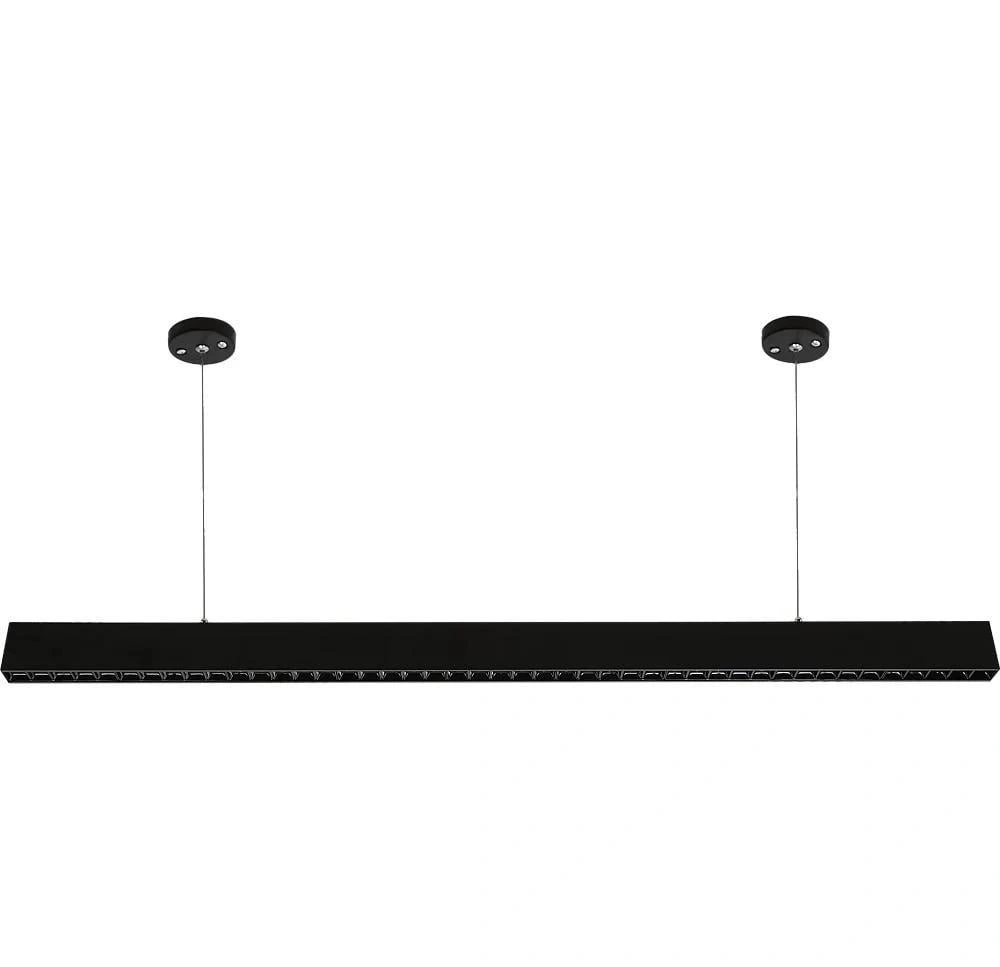
A lineup of linear panels often shows length and power. Rayvon lists its standard linear panel for magnetic track in 30 cm / 15 W, 60 cm / 30 W and 90 cm / 40 W versions. Those figures help you plan the layout and check electrical demand. Ask for the model’s light output when you need to compare how much light the versions produce.
Three figures on the product sheet
Lumens (lm) express the amount of light emitted. Watts (W) express electrical power. Divide the complete luminaire’s light output in lumens by its electrical input in watts to get luminous efficacy, written as lm/W. For example, a hypothetical fitting delivering 800 lm at 10 W has an efficacy of 80 lm/W. Use figures measured for the same version and configuration of the fitting.
Light on the shelf or table
Two units can deliver the same total lumens and spread them differently. A beam concentrated on a small area can make that area brighter than a wider distribution with the same total output. A linear panel and a directional spotlight can therefore serve different roles along the same track. Compare modules with a similar job, such as two options intended to light the same work surface.
For that comparison, mark the surface on the plan and write down the distance from the light to it. Read the beam information alongside the output. When possible, test a sample in the intended position and see how far the light spreads beyond the surface.
Comparison checklist
- Record the length and power of the exact version you are considering.
- Ask for luminaire lumens and the light distribution for that version.
- Group modules by the job they will do, then compare efficacy within each group.
Use these checks to compare Magnetic lighting modules and Linear office lighting. Match each comparison to the selected model and its intended location.
Sources
- U.S. Department of Energy – Commercial and Industrial LED Luminaires
- U.S. Department of Energy – What Is Energy Efficiency?
From the RAYVON catalog